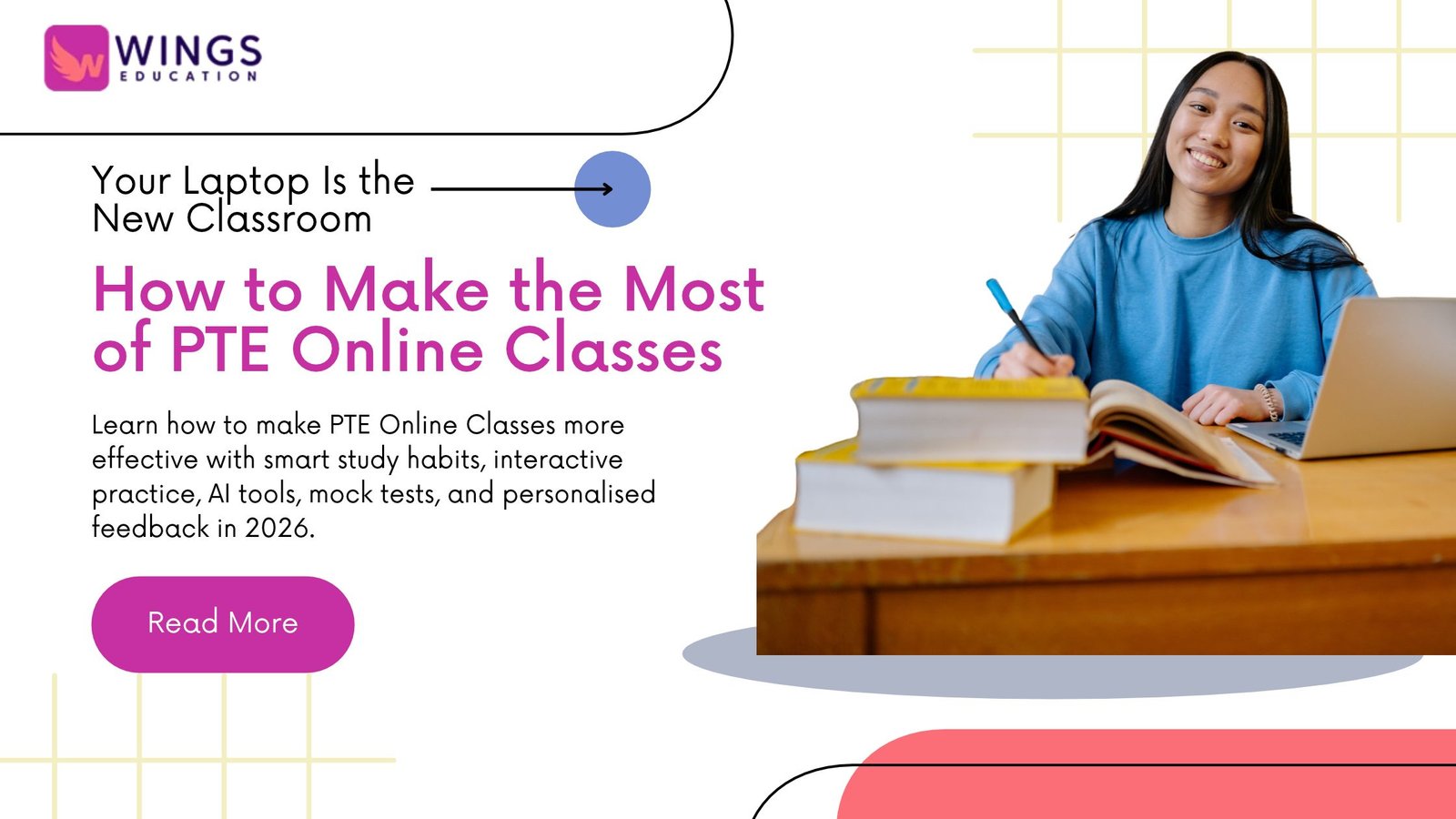
Your Laptop Is the New Classroom: How to Make the Most of PTE Online Classes
Learn how to make PTE Online Classes more effective with smart study habits, interactive practice, AI tools, mock tests, and personalised feedback in 2026.
A classroom once meant four walls, a board, rows of desks, and a teacher standing at the front. Today, that picture looks very different.
For many PTE candidates, the classroom may be a laptop on a desk, headphones beside the keyboard, a notebook filled with vocabulary, and a small microphone waiting for the next speaking exercise.
The physical classroom has not disappeared. There is now a digital version of it.
PTE Online Classes have changed how students can approach English-language test preparation. Lessons can happen from home, practice materials can be accessed from almost anywhere, and feedback can arrive without requiring students to travel to a coaching centre.
But convenience alone does not guarantee effective learning.
Having a classroom on your laptop does not automatically mean you are learning efficiently. The real advantage comes from knowing how to use that digital environment properly.
In 2026, online PTE preparation can involve live lessons, recorded sessions, mock tests, digital practice platforms, pronunciation exercises, automated feedback, screen sharing, collaborative activities, and AI-supported learning tools.
Finding study materials is no longer the only difficulty.
It is figuring out how to use it without getting overwhelmed.
1. Treat Your Laptop Like a Classroom, Not Entertainment
Although the first step seems straightforward, it can have a big impact.
When you study from home, the same laptop may be used for lessons, social media, entertainment, shopping, gaming, emails, and countless other distractions.
That creates a problem that traditional classrooms naturally avoid.
In a physical classroom, your surroundings tell your brain that it is time to learn. At home, you have to make that signal by yourself.
Before an online lesson begins, prepare your study environment.
Keep your notebook nearby. Put your phone in focus mode or put it aside. Close unnecessary browser tabs. Keep your headphones ready. Make sure your microphone and internet connection work properly.
These small habits can turn an ordinary room into a focused learning space.
The objective is both pragmatic and psychological.
When you sit down for a PTE lesson, your brain should recognise:
“This is study time.”
2. Choose Active Learning Over Passive Watching
One of the biggest traps in online education is passive learning.
A student watches a 45-minute lesson, understands everything the teacher says, takes a few notes, and finishes the session feeling productive.
But understanding a lesson and being able to finish a task are two different things.
PTE preparation requires active participation.
If a teacher demonstrates a speaking task, do not simply watch.
Speak.
If a writing strategy is explained, write.
If a listening exercise is discussed, attempt it before looking at the answer.
If a reading technique is introduced, apply it immediately.
This turns the laptop from a television screen into an interactive learning tool.
The most valuable question after an online lesson is not, “Did I understand the teacher?”
It is:
“Can I do this myself?”
3. Make Speaking Practice Part of Every Study Session
Speaking can feel particularly challenging in an online environment because students may be tempted to remain silent.
They listen to explanations but do not speak enough themselves.
That is a missed opportunity.
The computer can actually become one of the best tools for speaking practice because it allows students to record their own responses.
Record yourself answering a speaking prompt.
Then listen.
Do you pause too often?
Are certain words unclear?
Do you repeat the same phrases?
Are you speaking too quickly?
Does your voice become quieter at the end of sentences?
Self-recording can initially feel uncomfortable.
That discomfort is useful.
You are hearing your English from the listener’s perspective rather than experiencing it only from inside your own head.
Over time, this can make weaknesses easier to identify.
4. Do Not Confuse Speaking Quickly With Speaking Fluently
Online PTE preparation often includes timed speaking activities, and students sometimes develop an unhealthy obsession with speed.
They believe that speaking faster means they are speaking better.
It does not.
Fluency is about maintaining a natural and controlled flow of speech. A response delivered at high speed but filled with hesitation, repetition, unclear pronunciation, and unfinished ideas may not be effective.
During online practice, focus on rhythm.
Speak at a pace that allows you to remain understandable.
Use natural pauses when necessary.
Avoid filling every silence with “um,” “uh,” or repeated words.
The objective is controlled speech, not a race against the clock.
5. Turn Your Headphones Into a Listening Laboratory
Headphones are not simply accessories for attending online lessons.
They can become a powerful listening tool.
Use them to expose yourself to different forms of spoken English.
Listen to academic talks, interviews, educational podcasts, lectures, and discussions. Pay attention not only to individual words but also to how speakers connect ideas.
Notice changes in tone.
Listen for emphasis.
Identify transitions.
Try to predict where an explanation is heading.
Next, use your own words to summarize what you heard.
This type of practice develops a deeper listening habit.
Instead of hearing English as a stream of individual words, you begin to hear structure and meaning.
That can be particularly useful for an examination where listening may interact with other language skills.
6. Build a Digital Vocabulary Bank Instead of a Giant Word List
Many students create huge vocabulary lists.
Some contain hundreds or even thousands of words.
Then they rarely use them.
It can be far more beneficial to have a smaller, more useful word bank.
When you encounter a new word, record more than its meaning.
Write down the word, its common form, an example sentence, related words, and perhaps a synonym or antonym.
Then actually use it.
For example, if you learn the word “significant,” create several sentences using it naturally.
This turns vocabulary from something you recognise into something you can actively produce.
Your laptop makes this process easy because digital notes can be reorganised, searched, updated, and reviewed regularly.
The best vocabulary list is not the longest one.
It is the one you actually use.
7. Use AI as a Practice Partner, Not a Shortcut
Artificial intelligence has become increasingly accessible to language learners.
Students can use AI-based tools to generate practice questions, simulate conversations, review writing, brainstorm ideas, and create additional exercises.
That can make online preparation more flexible.
However, there is a crucial difference between utilizing AI to avoid learning and using it for practice.
If an AI tool writes an answer for you, copying that answer does not necessarily improve your ability.
Instead, use technology to challenge yourself.
Ask for a practice prompt.
Respond independently.
Then compare your answer with feedback.
Ask why a particular sentence could be improved.
Try rewriting it.
This creates a learning loop.
Attempt → Feedback → Correction → New attempt.
The human learner remains at the centre of the process.
8. Make Mock Tests a Regular Reality Check
Online preparation makes mock tests easier to access, but that convenience can create another problem.
Students sometimes complete too many mock tests without analysing their results.
A fake test shouldn’t just provide you with a score.
It should tell you something about your preparation.
After each test, review the experience.
Which sections felt difficult?
Where did you lose time?
Which mistakes appeared repeatedly?
Did you perform differently when you were under pressure?
Were your listening errors caused by vocabulary, concentration, or note-taking?
Did you misinterpret the question or did you just make a thoughtless error?
These questions are more valuable than the score alone.
Think of a mock test as a diagnostic appointment.
The result identifies symptoms.
Your analysis looks for causes.
9. Make a Study Plan That Works for Your Real Life
One of the biggest advantages of online learning is flexibility.
But flexibility without structure can quickly become procrastination.
A student may say, “I will study later.”
Later becomes tomorrow.
Tomorrow becomes next week.
Suddenly, the examination date is approaching.
Making a realistic schedule is a better strategy.
If you have two hours available, you do not necessarily need to spend the entire period completing full-length tests.
You might spend 30 minutes on speaking, 30 minutes on listening, 30 minutes reviewing errors, and 30 minutes working on writing or reading.
The precise structure may alter based on your areas of weakness.
The important thing is consistency.
Thirty focused minutes every day can be more valuable than five distracted hours once a week.
10. Keep an Error Journal
One of the simplest digital study tools can also become one of the most powerful: an error journal.
Whenever you make a recurring mistake, record it.
But do not simply write the incorrect sentence.
Record three things:
What I did.
Why it was wrong.
What I should do next time.
Over several weeks, patterns begin to appear.
Perhaps you frequently miss articles.
Maybe you confuse verb tenses.
Perhaps your speaking responses become disorganised when you encounter unfamiliar topics.
Maybe you repeatedly lose marks because you rush through instructions.
Once the pattern becomes visible, preparation becomes more targeted.
You stop studying everything equally.
You start studying what actually needs attention.
11. Keep Your Screen Time Intentional
More online study does not necessarily mean better preparation.
Hours spent staring at a screen can lead to mental fatigue.
When concentration drops, learning efficiency often drops with it.
Use breaks deliberately.
After an intensive lesson, step away from the screen.
Walk around.
Drink water.
Rest your eyes.
Return when your concentration has recovered.
Digital learning works best when it is combined with physical breaks.
The laptop may be the classroom, but you do not have to remain glued to the desk all day.
12. Learn to Handle Unfamiliar Questions
Adaptability is one of the main advantages of thorough PTE preparation.
Students who rely entirely on memorised responses can struggle when a prompt looks different from what they expected.
Online practice should therefore include variety.
Do not repeatedly practise only the easiest topics.
Challenge yourself with unfamiliar subjects.
Try different question types.
Practise responding without looking at prepared notes.
This teaches your brain to react rather than recall.
That distinction matters.
Recall asks:
“What answer did I memorise?”
Adaptation asks:
“What can I do with the information in front of me?”
The second ability is much harder to break.
13. Make Your Online Classes Interactive
If you are attending live PTE Online Classes, do not become invisible behind the screen.
Ask questions.
Answer when the teacher invites participation.
Share your doubts.
Request feedback on recurring mistakes.
Participate in speaking activities.
Use the chat when appropriate.
Online education becomes much more effective when students interact rather than simply watch.
A teacher cannot always identify every problem through a silent screen.
Your questions provide information about where you are struggling.
The more clearly you communicate your difficulties, the more useful the feedback can become.
14. Review Lessons Before Moving Forward
Another common online-learning mistake is collecting lessons without revisiting them.
Students finish one class and immediately move to another.
The result is a large amount of information with surprisingly little retention.
Review should therefore become part of the learning cycle.
At the end of a lesson, write down the three most important ideas you learned.
The next day, try to explain those ideas without looking at your notes.
Then apply them in a practice task.
This small habit can turn information into knowledge.
15. Simulate the Real Test Environment
A laptop at home is comfortable.
The actual examination environment may not be.
That difference can affect performance.
During certain practice sessions, replicate genuine conditions as the test draws near.
Sit at a desk.
Use a microphone.
Follow time limits.
Avoid checking your phone.
Do not pause the test whenever something becomes difficult.
Practise continuing even after making a mistake.
This helps reduce the shock of moving from comfortable home practice to a controlled examination environment.
The objective is not to make practice stressful.
It is to make the real experience feel familiar.
The Laptop Is Only the Classroom — You Are Still the Learner
The greatest advantage of PTE Online Classes is not that students can study from home.
It is that learning can become more flexible, interactive, personalised, and accessible.
But technology itself does not create progress.
A laptop cannot practise speaking for you.
An AI tool cannot build your confidence for you.
A mock test cannot analyse its own mistakes for you.
A digital vocabulary list cannot remember the words on your behalf.
The learner still has to participate.
That is why effective online preparation depends less on how many hours you spend looking at a screen and more on what you actually do during those hours.
Watch less passively.
Speak more.
Write more.
Listen actively.
Review mistakes.
Ask questions.
Practise unfamiliar tasks.
Use technology intelligently.
And most importantly, turn every mistake into information.
The modern digital classroom is powerful because it can bring lessons, practice, feedback, recordings, mock tests, and learning tools together in one place.
But the screen is only the beginning.
The real classroom is the work you do after the lesson ends.
And when your laptop closes, the learning should not stop.
It should continue in the way you speak, listen, read, write, think, and communicate in English every day.