
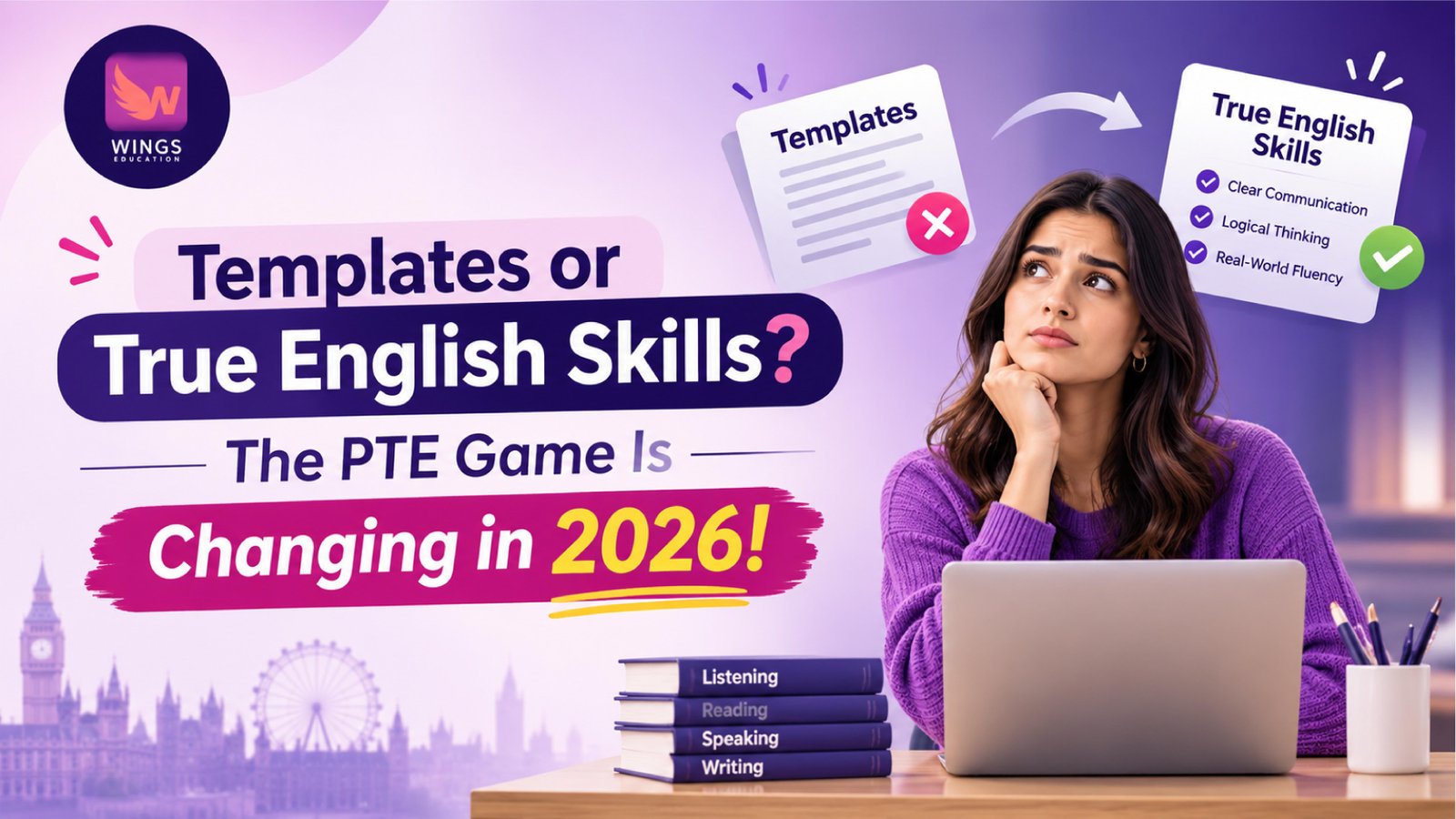
Are Traditional PTE Templates Still Effective in 2026?
In 2026, are conventional PTE templates still useful? Explore how memorised structures influence PTE performance and why natural English matters more than ever.
Introduction: The Changing Face of PTE Preparation
For years, templates have been a familiar part of PTE preparation. From carefully memorised essay introductions to ready-made speaking structures, students have relied on these shortcuts to organise their thoughts, save time and approach examination tasks with greater confidence. For many candidates, templates have even become a comfort zone. Instead of worrying about what to say next, they can follow a familiar structure and concentrate on completing the task.
However, English proficiency examinations are not simply about remembering sentences or reproducing familiar expressions. They are designed to evaluate how effectively candidates understand, communicate and use the English language in different situations.
This distinction has grown in significance in 2026. As students explore new preparation methods, artificial intelligence tools and changing examination patterns, an important question deserves attention: are traditional PTE templates still effective, or are they gradually losing their usefulness?
The answer is not entirely straightforward. Templates have not become completely irrelevant, but the way students use them needs to change. A memorised structure can provide direction, while an overdependence on prepared sentences can make communication sound unnatural. Understanding where templates help and where they create limitations is essential for anyone preparing for PTE Academic.
Why Did Traditional PTE Templates Become So Popular?
The popularity of PTE templates did not happen without reason. Preparing for an English proficiency examination can be challenging, particularly for students who struggle with organising their thoughts under time pressure.
Imagine being asked to describe an unfamiliar image, summarise a lengthy passage or write an essay within a limited period. Even someone with reasonable English knowledge may find it difficult to decide how to begin, which information to include and how to organise the response.
Templates offered a practical solution to this problem.
Students began using standard sentence structures for different examination tasks. For instance, essay templates provided introductions, body paragraph arrangements and conclusions. Speaking templates helped candidates organise descriptions and deliver responses without unnecessary hesitation.
There were three major reasons behind their popularity:
- Time management: Familiar structures reduced the time required to organise responses.
- Confidence: Students felt more comfortable when they knew how to begin and finish a task.
- Consistency: Repeated practice with a particular structure helped candidates develop a predictable response pattern.
For beginners, these benefits were particularly valuable. A student who had never written an English essay could use a basic framework to understand paragraph organisation. Similarly, someone who struggled with speaking could use a simple structure to develop a more organised response.
The problem began when a useful learning framework gradually turned into a memorization strategy.
Instead of learning how to communicate effectively, some candidates started concentrating on remembering entire paragraphs and reproducing them during examinations. This created a gap between knowing a template and actually demonstrating English proficiency.
Are Conventional PTE Templates Still Useful in 2026?
Yes, traditional PTE templates can still be useful in 2026, but their effectiveness depends on how they are applied.
A template should function as a supporting structure rather than a replacement for language ability. It can help candidates organise information, maintain logical flow and avoid unnecessary confusion. However, it cannot independently demonstrate whether someone understands a topic or can communicate meaningful ideas.
Consider two students attempting the same speaking task.
The first student memorises an entire response structure and uses it regardless of the question. Although the response may sound organised, the information might not accurately address the task.
The second student understands the purpose of the template but adjusts the structure according to the information provided. Their response contains relevant details and sounds more natural.
The difference is not necessarily the template itself. It is the candidate’s ability to use language appropriately.
In 2026, students should therefore move away from memorising complete answers and focus on understanding flexible response patterns.
A good template should make communication easier, not make every answer sound identical.
The Biggest Problem with Memorised PTE Templates
One of the most common mistakes in examination preparation is confusing memorisation with mastery.
Remembering a sentence does not automatically mean someone understands how to use it. A student might memorise an impressive introduction containing advanced vocabulary but struggle to explain a simple idea without referring to prepared material.
This becomes particularly problematic when the examination question requires specific information.
- Irrelevant Content Can Weaken a Response
A memorised structure may not always suit the question being asked. When candidates try to fit every topic into the same framework, they risk including unnecessary sentences.
For example, an essay about environmental pollution requires a different discussion from an essay about the importance of technological education. Although both can follow a similar paragraph structure, the arguments, examples and vocabulary should reflect their individual topics.
The objective is not to fill the response with familiar sentences. It is to communicate relevant information clearly.
- Overused Expressions Can Make Communication Sound Artificial
Some candidates repeatedly use complicated expressions because they believe sophisticated vocabulary automatically creates a better impression.
However, natural communication does not depend on using the longest possible sentences.
A clear sentence such as “Technology has changed the way people communicate” can be more effective than an unnecessarily complicated sentence that makes the same point.
Students should prioritise accuracy, clarity and relevance instead of trying to make every response sound academically impressive.
- Memorisation Can Create Pressure During Unexpected Questions
Memorised answers often work comfortably when the examination task resembles something the candidate has practised before.
But what happens when the question is unfamiliar?
A student who depends entirely on prepared sentences may struggle to adjust their response. They might pause, lose their train of thought or attempt to remember a sentence that does not fit the situation.
Developing the ability to think independently is therefore just as important as practising examination formats.
How PTE Speaking Preparation Is Changing
Speaking is one of the areas where the limitations of traditional templates become particularly noticeable.
A well-organised response is useful, but speaking is also about delivering information clearly and maintaining natural communication. Candidates need to understand what they are discussing rather than simply repeating a prepared sequence of sentences.
For example, in Describe Image, students often learn a fixed opening such as “The given image illustrates…” followed by a series of prepared connecting expressions.
There is nothing inherently wrong with using such an opening. It becomes a problem when the candidate spends more time remembering the structure than interpreting the image.
A better approach involves understanding the visual information first.
Candidates should identify the central subject, recognise important details, compare relevant figures when necessary and present their observations in a logical order.
Similarly, Repeat Sentence requires candidates to listen carefully and reproduce the spoken sentence. Memorised speaking templates cannot replace listening accuracy or short-term memory.
In Read Aloud, pronunciation, appropriate phrasing and clear delivery matter more than inserting prepared expressions.
The broader lesson is simple: speaking frameworks can organise a response, but they cannot replace the skills required to understand and communicate information.
PTE Writing: Are Essay Templates Still Worth Using?
Essay writing is another area where templates have maintained their popularity.
Many candidates prefer having a standard introduction, body paragraph arrangement and conclusion. This approach can reduce confusion, especially when writing under time constraints.
However, an essay should not become a collection of memorised sentences surrounding a small amount of actual discussion.
A useful writing framework should help students answer three important questions:
What is the central argument?
Every essay needs a clear direction. Candidates should understand the question before deciding whether they need to discuss advantages, disadvantages, causes, solutions or different perspectives.
How should the ideas be organised?
The conversation is simpler to follow when the paragraphs are organized logically. Each paragraph should develop a particular idea rather than introducing unrelated information.
Does the conclusion reflect the discussion?
A conclusion should bring the argument together instead of introducing an entirely new subject or repeating the introduction word for word.
For example, consider an essay discussing whether online education can replace traditional classrooms.
A student using a rigid template might write several generic sentences about the importance of education before reaching the actual topic.
A student using a flexible framework can immediately introduce the debate, explain the benefits and limitations of online learning, provide relevant examples and establish a balanced conclusion.
Both students may use the same basic paragraph structure, but the second demonstrates a stronger understanding of the question.
Therefore, essay templates remain useful when they support organisation rather than replace original thinking.
Understanding the Difference Between a Template and a Strategy
One important change students should make in their preparation is learning to distinguish between a template and an examination strategy.
Although the two are closely connected, they serve different purposes.
A template provides a familiar structure. A strategy explains how to approach a task, understand its requirements and make appropriate decisions.
For example, a speaking template might suggest introducing the subject, describing important information and concluding the response.
A speaking strategy goes further. It teaches candidates how to identify relevant information, avoid unnecessary details, manage speaking time and maintain clear delivery.
Similarly, a writing template provides paragraph arrangements, while a writing strategy helps candidates interpret the question, develop arguments and use appropriate vocabulary.
The difference becomes especially important when students encounter unfamiliar tasks.
Someone who knows only a template may struggle when the question changes. Someone who understands the underlying strategy can adapt their response without depending on memorised sentences.
This is why effective PTE Academic preparation should focus on developing transferable skills rather than collecting hundreds of ready-made answers.
The Role of AI and Technology in Modern PTE Preparation
Technology has significantly changed how students approach English proficiency examinations.
Today, candidates have access to digital practice platforms, automated feedback systems, pronunciation tools and artificial intelligence applications that can help them identify weaknesses.
These resources have made preparation more accessible, but they have also created new challenges.
Some students use AI tools to generate essay templates, speaking responses and collections of advanced vocabulary. Although these materials can provide useful learning examples, copying them without understanding their content can encourage the same memorisation habits that traditional preparation methods created.
AI-generated responses should be treated as learning resources rather than ready-made examination answers.
For instance, students can use technology to explore alternative ways of expressing an idea, understand grammatical mistakes or practise organising an argument. They can also compare their original writing with corrected versions to identify areas that need improvement.
However, technology cannot replace consistent practice and independent language development.
It is also important to understand that AI-assisted preparation does not mean that every aspect of the actual examination is evaluated through an identical automated process. Candidates should refer to official Pearson information for current scoring and examination policies rather than relying on online assumptions.
The smartest use of technology is not to find more sentences to memorise. It is to understand how language works and improve the ability to use it independently.
What Should Students Use Instead of Traditional Memorisation?
Abandoning every template is not necessary. In fact, doing so may create additional confusion for beginners.
A more effective approach is to develop flexible frameworks supported by regular language practice.
Here are some practical ways to make preparation more meaningful.
- Learn Sentence Patterns Instead of Complete Paragraphs
Instead of memorising an entire introduction, understand how to introduce a topic in different ways.
For example:
- One possible reason for this development is…
- An important factor contributing to this situation is…
- This issue has become increasingly relevant because…
Learning sentence patterns allows students to communicate similar ideas using different expressions.
It also helps them avoid repeating identical sentences across multiple tasks.
- Practise with Unfamiliar Topics
Practising only familiar questions can create a false sense of confidence.
Candidates should regularly attempt topics they have never prepared for before. This encourages independent thinking and helps them become comfortable with unfamiliar vocabulary and situations.
For writing, they can select random social, educational, environmental and technological topics.
For speaking, they can practise describing unfamiliar images, explaining everyday situations and summarising information.
The purpose is to develop adaptability.
- Build Vocabulary Through Context
Memorising long vocabulary lists may seem productive, but remembering a word is different from knowing how to use it.
Students should learn vocabulary through sentences, reading materials, conversations and practical examples.
For instance, understanding how words such as “significant”, “considerable”, “beneficial” and “essential” function in different contexts is more useful than simply remembering their definitions.
A strong vocabulary should improve communication rather than make it unnecessarily complicated.
- Record and Evaluate Your Speaking Practice
Recording speaking responses can help candidates recognise issues they may not notice while practising.
They can listen for unclear pronunciation, unnecessary pauses, repeated expressions, grammatical mistakes and unnatural sentence patterns.
Instead of recording the same answer repeatedly until it sounds memorised, students should attempt different topics and focus on improving their delivery.
- Analyse Mistakes Instead of Only Checking Scores
A mock test score provides an indication of performance, but the real value of practice lies in understanding mistakes.
If a student repeatedly loses marks in listening-related tasks, taking more mock tests without identifying the problem may not produce meaningful improvement.
They should investigate whether the difficulty comes from concentration, unfamiliar accents, vocabulary, spelling or understanding spoken information.
Every mistake should provide a direction for the next practice session.
Can Beginners Still Benefit from Traditional PTE Templates?
Absolutely.
For beginners, templates can act as training wheels. They provide initial support while students become familiar with examination tasks and develop basic language skills.
A candidate with limited experience in academic writing may benefit from learning how introductions, supporting paragraphs and conclusions work.
Similarly, students who feel nervous while speaking may find it easier to communicate when they have a basic response structure.
The important thing is to gradually reduce dependence on memorised material.
During the early stages, candidates can follow simple frameworks. As their confidence improves, they should start changing sentence structures, introducing their own examples and responding to unfamiliar topics.
This gradual transition allows students to develop confidence without becoming dependent on fixed answers.
The goal should be to reach a stage where the candidate understands the structure so well that they no longer need to remember every sentence.
A Smarter Way to Prepare for PTE Academic in 2026
Preparing for PTE Academic requires more than knowing the examination format. Candidates need a balanced approach that combines language development, task familiarity and effective time management.
A practical preparation routine can begin with identifying individual strengths and weaknesses.
Students who struggle with speaking should spend time improving pronunciation, listening comprehension and spontaneous communication. Those who find writing difficult should practise developing arguments, organising paragraphs and correcting grammatical errors.
Regular reading can improve vocabulary and sentence understanding, while listening to English podcasts, interviews and educational discussions can help candidates become familiar with different speaking styles.
Mock tests should also remain part of the preparation process. They help students understand the examination environment, practise time management and evaluate their progress.
However, practice should never become a repetitive exercise without reflection.
A candidate who completes five mock tests without reviewing mistakes may learn less than someone who completes two tests and carefully analyses every weakness.
Consistency, feedback and improvement are more valuable than the number of practice tests completed.
Conclusion: Templates Are Not the Enemy, Overdependence Is
So, are traditional PTE templates still effective in 2026?
Yes, but their purpose needs to be understood correctly.
Templates can help candidates organise their thoughts, manage examination time and approach unfamiliar tasks with greater confidence. They remain useful as learning frameworks, particularly for beginners who need guidance in speaking and writing.
However, memorising complete answers and relying on fixed expressions can limit flexibility and prevent students from developing genuine communication skills.
The future of successful PTE preparation lies in combining structure with independent thinking. Students should understand how to organise responses, develop meaningful arguments, interpret information and communicate naturally.
A good template can show you where to begin, but it cannot decide what you should say.
Ultimately, the objective of PTE Academic is not to reward candidates for remembering the most sentences. It is to assess their ability to use English effectively. In 2026, students who understand this distinction can approach their preparation with greater confidence, flexibility and purpose.