AASW English Language Requirements 2026: IELTS Scores, Rules & Exemptions Explained
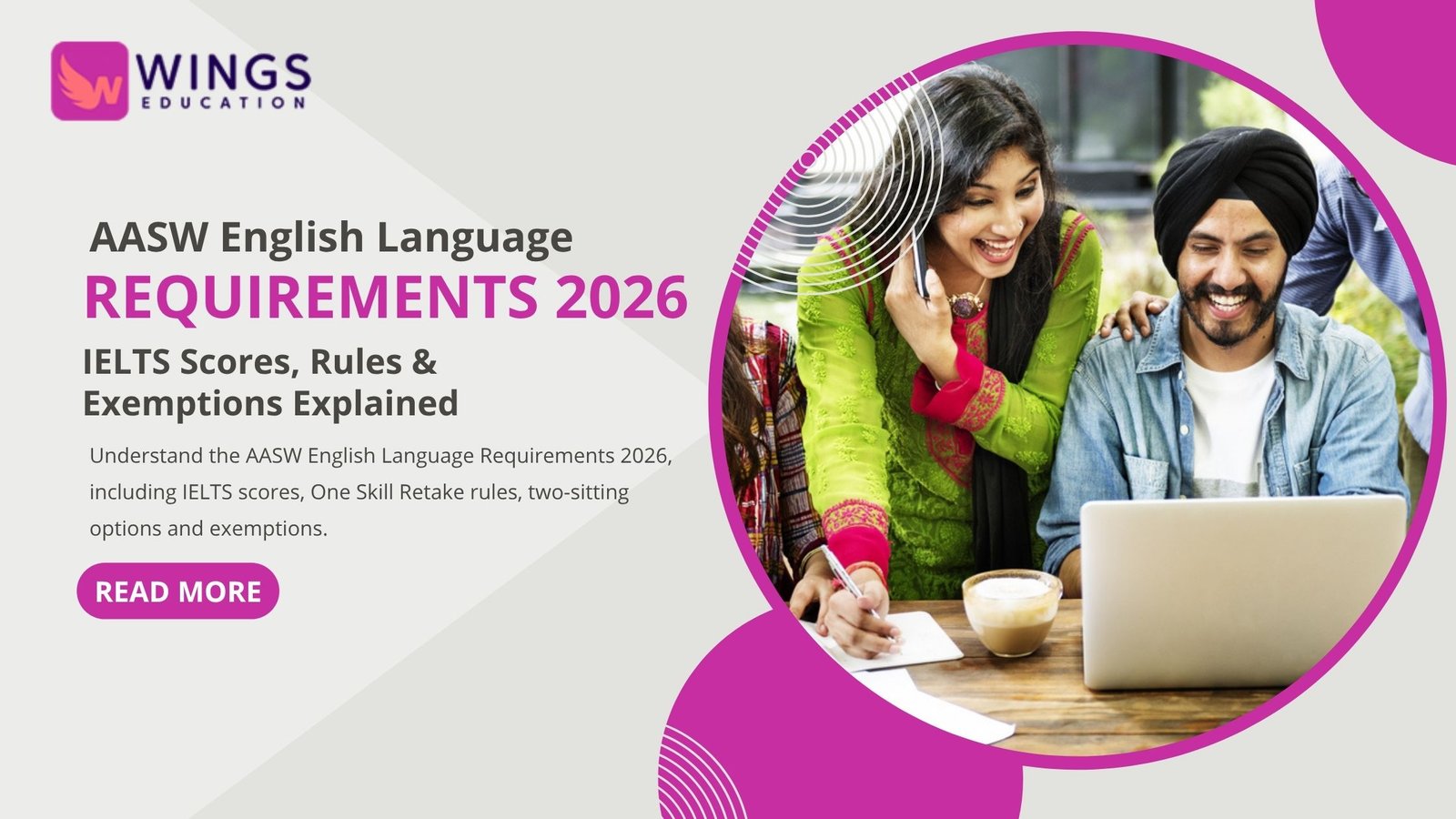
Understand the AASW English Language Requirements 2026, including IELTS scores, One Skill Retake rules, two-sitting options and exemptions.
For social workers planning to build a professional career in Australia, English proficiency is more than another item on an application checklist. It is part of demonstrating that they can communicate clearly, understand complex situations and work safely with individuals, families and communities.
In 2026, the AASW English Language Requirements continue to place a strong emphasis on high-level English proficiency. The Australian Association of Social Workers (AASW) currently accepts IELTS Academic and, under its updated policy, IELTS Academic One Skill Retake for demonstrating English proficiency. The updated One Skill Retake pathway has been accepted by AASW from 20 May 2026.
But there is an important detail that applicants often overlook: achieving an overall IELTS score of 7.0 is not, by itself, enough. The scores in individual components—Listening, Reading, Writing and Speaking—also matter.
So, what exactly do the AASW English Language Requirements 2026 look like? Can applicants combine scores from different tests? Who can qualify for an exemption? And what happens if one IELTS component falls below the required level?
Let’s break it down.
Why Does AASW Have an English Language Requirement?
Social work is fundamentally built around communication.
A social worker may need to interview a client, understand sensitive information, prepare professional documentation, communicate with other professionals, explain available services or advocate for someone’s needs. A misunderstanding in any of these situations can have serious consequences.
For this reason, AASW treats English proficiency as a professional requirement rather than simply a migration formality. The organisation states that its English requirements for professional practice can be higher than the English requirements established by Australia’s Department of Home Affairs for migration purposes.
This distinction is important.
Someone might satisfy an English requirement for a particular visa but still need to meet the separate English language standard required for an AASW assessment.
In other words, visa English and professional English are not necessarily the same thing.
What Are the AASW English Language Requirements in 2026?
The standard is straightforward at first glance: applicants generally need to demonstrate a minimum score of 7.0 in each of the four IELTS Academic components—Listening, Reading, Writing and Speaking.
However, AASW provides more than one way to achieve this.
The current policy outlines three pathways for demonstrating English proficiency. These include achieving the required scores in one IELTS Academic sitting, meeting the component requirements across two IELTS Academic sittings within six months, or using an IELTS Academic sitting together with an eligible One Skill Retake.
Option 1: Achieve 7.0 in Every Component in One Sitting
The most direct route is to complete one IELTS Academic test and achieve at least 7.0 in Listening, Reading, Writing and Speaking.
For example:
Listening: 7.0
Reading: 7.5
Writing: 7.0
Speaking: 7.5
This satisfies the component-level requirement because every individual score reaches at least 7.0.
The important point is that applicants should not focus exclusively on the overall band score. A strong performance in three areas cannot automatically compensate for a weaker fourth component.
For someone targeting AASW, therefore, the goal is not simply “get an IELTS 7.” It is closer to “build four separate 7.0 performances.”
That difference can completely change the way a candidate prepares.
Option 2: Use Two IELTS Academic Test Sittings
What happens if someone gets a 6.5 in one component but performs better in the next test?
AASW allows applicants to demonstrate the required proficiency through a maximum of two IELTS Academic test sittings completed within a six-month period, provided the required component scores are achieved across those sittings.
There is one critical condition: no individual component score can be below 6.5. Across the two sittings, applicants must achieve at least 7.0 in each of the four components.
Consider this example:
1: Test Listening 7.0 | Reading 7.0 | Writing 6.5 | Speaking 7.0
2: Test
Listening 7.0 | Reading 6.5 | Writing 7.0 | Speaking 7.5
Here, the results can be combined because each component reaches 7.0 across the two tests, and no component falls below 6.5.
This option can be particularly useful for candidates who are strong overall but have one or two inconsistent skills.
However, it should not be interpreted as permission to collect unlimited IELTS results and select the best scores from each. The AASW policy specifically limits the pathway to two sittings within six months and sets minimum component conditions.
Option 3: IELTS One Skill Retake Changes the Strategy
One of the notable developments in the AASW English Language Requirements 2026 is the inclusion of the IELTS Academic One Skill Retake pathway.
From 20 May 2026, AASW began accepting IELTS Academic One Skill Retake under the conditions specified in its English language policy.
This can make a significant difference for a candidate who performs well in three areas but misses 7.0 in one.
For example:
Original IELTS Academic test:
Listening 7.0
Reading 7.5
Writing 6.5
Speaking 7.0
If the candidate is eligible, they may take an IELTS Academic One Skill Retake for Writing and need to achieve at least 7.0 in that retaken component.
The policy requires the original full IELTS Academic test to be taken on computer at an eligible test centre, with the IELTS score received before the One Skill Retake. The retake must be completed within 60 days of the original test date.
This creates a useful alternative to repeating all four sections when only one skill needs improvement.
But there is a catch: One Skill Retake is not an unlimited second chance. It has specific eligibility requirements, timing rules and score conditions.
How Long Are IELTS Results Valid for AASW?
Timing matters when submitting English-language evidence.
Under the current AASW policy, test results must have been obtained within three years before submitting an AASW qualification assessment. For the One Skill Retake pathway, additional timing requirements apply.
For example, if someone completed an IELTS test several years ago, it is not enough to assume that the result remains acceptable simply because the candidate still has the original Test Report Form.
Applicants should check the date of their IELTS results against the date they intend to submit their AASW assessment.
This is particularly important for people who have completed their English test well before beginning the migration or professional assessment process.
Can You Get an AASW English Test Exemption?
Yes—but the exemption is based on specific educational circumstances, not simply on being a fluent English speaker.
AASW may grant an exemption where an applicant can demonstrate that they completed all secondary education from Years 7 to 12 in English in one of the specified countries and also successfully completed at least three years of full-time tertiary education at bachelor’s level or higher, taught and assessed in English, in one of those countries.
The countries currently specified by AASW are:
Australia, Canada, New Zealand, Republic of Ireland, South Africa, United Kingdom and United States of America.
The two educational requirements work together.
Completing university education in English alone does not necessarily establish eligibility for the exemption. Likewise, studying at an English-medium school does not automatically satisfy the complete exemption criteria.
Applicants need to consider both their secondary and tertiary education history.
What Evidence Is Needed for an Exemption?
An exemption is not simply claimed by writing “English was my medium of instruction” on an application.
Applicants may need to provide evidence such as secondary school results, documentation or a letter from the relevant school or education authority confirming that the education was completed, taught and assessed in English.
Tertiary education records are also required to demonstrate successful completion of the qualifying period of study in English.
Where certain education records cannot be supplied, AASW indicates that a Statutory Declaration may be acceptable in some circumstances. However, the declaration needs to contain the relevant details, such as the educational institution, years studied and country of study.
This makes documentation just as important as eligibility.
A person may genuinely have studied in English but still need appropriate evidence to support an exemption request.
Which English Tests Does AASW Accept?
This is one area where applicants should be particularly careful.
The current AASW information states that it only accepts IELTS Academic and IELTS Academic One Skill Retake for the applicable English-language requirement.
That means applicants should not automatically assume that an English test accepted by another Australian organisation will also satisfy AASW.
For example, people researching social work migration may encounter information about PTE, OET, TOEFL or other English tests on different websites. Acceptance by another organisation does not automatically mean acceptance by AASW.
This distinction is also why a search such as pte gold coast can produce plenty of English-test preparation and testing information without necessarily answering the specific question of whether PTE satisfies the AASW English requirement.
The safest approach is to check the current AASW policy before selecting an English test.
AASW Requirements vs General Migration English Requirements
One of the easiest mistakes to make is treating the AASW requirement and the Department of Home Affairs requirement as interchangeable.
They are not necessarily identical.
The Department of Home Affairs establishes English-language requirements for Australian migration and visa purposes, while AASW establishes English requirements connected to professional social work assessment and practice. AASW itself notes that its standards may be higher in some circumstances.
This means an applicant may need to satisfy more than one English-related requirement depending on their individual migration pathway.
Think of it as two different doors:
The migration door asks whether you meet the relevant visa requirement.
The professional assessment door asks whether you meet the English standard required by the assessing authority.
Meeting one does not automatically unlock the other.
What If You Have a Strong Overall IELTS Score but One Weak Section?
This is where understanding the AASW rules becomes particularly important.
Suppose someone receives an overall IELTS band score of 7.5 but has:
Listening 8.0
Reading 8.0
Writing 6.5
Speaking 7.5
The impressive overall score does not erase the Writing result.
For the standard AASW pathway, the applicant still needs to satisfy the component-level requirement through one of the accepted options.
Depending on the circumstances, the candidate may consider another IELTS Academic sitting or an eligible One Skill Retake pathway.
This is why preparation should focus on balanced performance, rather than chasing an impressive overall average.
A candidate who can consistently achieve 7.0 in all four skills may be in a stronger position than someone who scores 8.5 in Reading but struggles repeatedly with Writing.
Preparing for the AASW English Requirement
Preparing for AASW is not simply about memorising IELTS vocabulary.
The four components test different abilities, and social work itself involves practical communication. A candidate needs to understand written information, communicate ideas clearly, listen accurately and express themselves effectively.
Writing preparation, for example, should involve learning how to develop a clear argument, organise information logically and maintain appropriate grammatical accuracy. Speaking preparation should go beyond memorised answers and focus on responding naturally and coherently.
Listening practice can benefit from exposure to different accents and speaking speeds, while Reading preparation should develop the ability to identify relationships between ideas rather than simply locate individual words.
The most useful preparation strategy is therefore diagnostic: identify the weakest skill, understand why errors occur, and build that skill systematically.
A Small Score Can Have a Big Impact
The AASW English requirement illustrates an important lesson about professional assessments: small score differences can matter.
A 6.5 and a 7.0 may appear close on a score report, but when a professional authority establishes a minimum component score, that half-band can determine whether the evidence meets the requirement.
This is particularly relevant to candidates who repeatedly achieve high scores in three skills but remain just below the target in one.
Instead of endlessly repeating the complete test without a strategy, candidates should analyse their performance. Is Writing affected by task response? Is Speaking losing marks because answers are too short? Is Reading affected by timing? Is Listening accuracy dropping in the final sections?
The score is the result. The mistakes reveal the solution.
AASW English Language Requirements 2026: The Bigger Picture
The current AASW framework gives applicants several ways to demonstrate the required level of English while maintaining a high professional standard.
The key routes can be understood simply:
One IELTS sitting: achieve at least 7.0 in all four components.
Two IELTS sittings: achieve at least 7.0 in every component across a maximum of two sittings within six months, with no component below 6.5.
IELTS + One Skill Retake: achieve 7.0 in three components in the original test, meet the applicable minimums, and use an eligible One Skill Retake to bring the remaining component to at least 7.0.
Educational exemption: demonstrate the specified secondary and tertiary education completed in English in one of the countries recognised by AASW.
The requirements may look complicated when viewed as policy language, but the underlying principle is clear: social workers seeking assessment need to demonstrate reliable, high-level English communication.
Final Thoughts
The AASW English Language Requirements 2026 are not simply about achieving a particular number on an IELTS result sheet. They reflect the communication demands of professional social work in Australia.
For most applicants, the central target remains 7.0 in each IELTS component. The two-sitting pathway and the newly accepted One Skill Retake option can provide additional flexibility, while specific educational backgrounds may allow eligible applicants to seek an exemption.
At the same time, applicants should avoid relying on outdated information. English-language policies can change, and requirements for one organisation may not apply to another.
Before booking a test or submitting an assessment, candidates should always check the latest AASW policy and make sure their test type, scores, dates and supporting documents satisfy the current rules.
For aspiring social workers, the goal is ultimately bigger than passing an English test. It is about developing the clarity, accuracy and confidence needed to communicate with people when communication matters most.